Inline PCT Transfer pushes Bluetooth Channel Sounding beyond 15 distance updates per second
We compared the conventional Bluetooth Ranging Service with the new Inline PCT Transfer approach. Our measurements show why eliminating the PCT relay path can make a substantial difference for high-rate ranging applications.
Sep 2026
Relayed vs Inline
Measuring the Update-Rate Trade-off in Bluetooth Channel Sounding
Update rate decides what a ranging application can do
An accurate distance measurement solves only half of the problem. The other half is cadence: a rate of a few updates per second can log where an asset was; a rate of dozens can follow it, close a control loop around it, and react while the reaction still matters. When engineers evaluate Bluetooth® Channel Sounding, accuracy usually gets the attention, but once the accuracy bar is met, the update rate decides what the application can do.
The update rate is not only a question of scheduling. Channel Sounding offers two ways to move the reflector’s measurement data to the initiator, and the two behave very differently under load. In our bench tests, that difference is the difference between holding your update rate and shedding it.
What PCT is and why it travels
Every Channel Sounding exchange measures the phase of radio tones between the two devices, initiator and reflector. Each side records what it hears; the reflector’s per-tone measurement is called the Phase Correction Term (PCT). Each device’s radio shifts the phase by its own small amount, and combining the two devices’ measurements cancels those shifts, exposing the channel’s phase along the full round trip, the information the distance calculation needs.
That leaves one design question: how does the reflector’s PCT reach the initiator? The standard answer moves it as data over the connection. The newer answer removes the journey altogether, and with it, much of the update-rate ceiling the standard answer imposes.
The two data paths
Channel Sounding supports two data paths for the reflector’s PCT. Our firmware ships both as variants, so to keep the two straight: throughout this piece, RAS means the standard relayed path and IPT means the newer inline path.
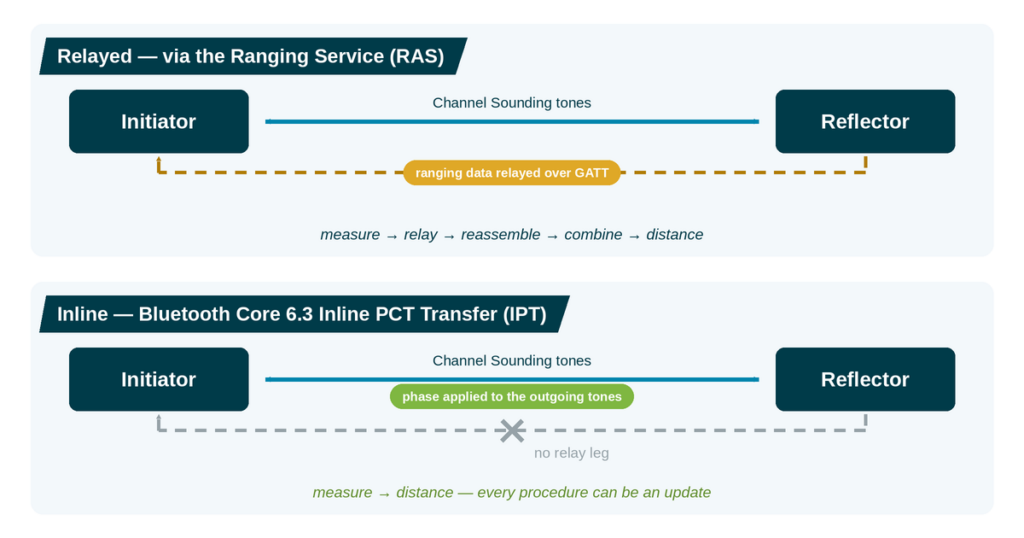
Relayed: Ranging Service (RAS). The initiator reads the reflector’s ranging data, PCT included, over the Ranging Service (RAS), an adopted GATT service, in real-time or on-demand mode, then reassembles it, combines it with its own PCT, and computes the distance.
Inline: Bluetooth® Core 6.3 Inline PCT Transfer (IPT). The reflector applies its measured PCT to the phase of the tones it transmits, so the initiator measures the combined phase directly on reception. The reflector’s PCT report shrinks to an amplitude reading, the relay leg disappears, and distance computation starts as soon as each ranging procedure completes.
What changes on the wire:
- Where the data goes. The relayed PCT travels as GATT packets on the same connection that carries the ranging procedures, in either the same connection interval or a subsequent one; whereas the inline correction never leaves the tones.
- What the relay costs. The relayed path needs service discovery and subscription before the first distance, buffering on the reflector, and reassembly on the initiator. The inline path has none of these.
- Who the connection time serves. The relay leg competes with ranging for connection time; the inline path frees that time for the next ranging procedure.
- Where the relay still runs. IPT covers phase-based ranging (PBR). If you also use round-trip-time (RTT) measurements, especially when your distance between devices exceeds 150 m, that data still travels via the Ranging Service, RAS and IPT are not mutually exclusive.
What we measured
We ran both data paths on the bench: a pair of Nordic nRF54L15 development kits with single antennas and a pair of Ezurio BL54L15U modules each with dual antennas (four-antenna-paths), each pair running the same MARS firmware release line, changing nothing but the data path.
Out of the box, the two paths are indistinguishable: in our bench tests, both RAS and IPT delivered about 3 distance updates per second at the shipped default cadence.
Push the update rate harder, and they separate:
- Inline (IPT) held its rate. Up to 15.9 Hz (distance updates per second) on the single-antenna pair and a continuous 13.4 Hz on the four-antenna-path pair. Stable for the whole run, every ranging procedure carrying its data.
- Relayed (RAS) shed its data. Under the same load, the relayed path could not move its ranging data fast enough: most of it was dropped, and the link could not be held.
The mechanism that the measurements can support: the inline path has no return leg to congest, so the connection time the relay would have consumed goes directly into additional ranging procedures. The relayed path has to move the data it produces first, and at rate, that is where it stalls.
Accuracy is not the trade-off which we thought was possible. On our 12 m cable-car reference campaign, both data paths passed the sub-metre bar, 2σ accuracy between 0.67 and 0.83 m across the measured board combinations, same algorithm, both data paths. What separates the two paths is not how well they measure; it is how much of the update rate survives load.
How we measured. Update rate: stationary bench pairs, with the update rate pushed progressively higher, once per data path. Accuracy: a 12 m cable-car campaign moving the pair along a reference track. Full configuration and raw data on inquiry.
What it means for your design
The choice is not which path is better; it is which constraint binds your design.
- Tight loops and fast-moving targets. If your application needs an update rate that survives load, closing control loops, tracking moving assets, ranging several device pairs at once, then the inline path is the one that keeps it.
- Multiple antenna paths. Every additional antenna path multiplies the ranging data a relayed design must move. If you use them for accuracy, angle estimation, or robustness, the relay leg grows with them; the inline path does not.
- Mixed requirements keep both. If you need RTT measurements alongside phase-based ranging, the Ranging Service stays in the design for the data IPT does not cover.
- Support is negotiated. IPT is negotiated between the two devices: both must support it and enable it. Devices that predate it, or links where one peer cannot enable it, run the relayed path, which works everywhere Channel Sounding does.
A practical rule from the bench: if your update-rate requirement sits near what the shipped default delivers, either path serves. If your application only works with a rate well above the default, plan for the inline path.
Inline PCT is the more efficient architecture, when available, as the update rate can be pushed higher, and the airtime is reduced.
How to engage
- The open-source MARS Channel Sounding firmware ships both data paths (RAS and IPT variants) for Nordic nRF54L15 development kits and tags, and for nRF54L15-based modules from Ezurio, Fanstel, KAGA FEI, Insight SIP, Minewsemi, Raytac, u-blox, and Würth; pair it with Metirionic’s Channel Sounding Evaluation Application to watch distances and update rates live.
- Consult. Request a consultation to map the two data paths onto your use case, operating environment, and update-rate requirements.
- Product context. See the MARS 4.3 release announcement for the stack behind these measurements, including Pathfinder II.
The Bluetooth® word mark is a registered trademark owned by Bluetooth SIG, Inc. Any use of such marks by Metirionic GmbH is referential only and does not indicate any affiliation with, sponsorship, or endorsement by Bluetooth SIG, Inc.