Rayleigh vs. CRLB — why “resolution” and “precision” are not the same, and what that means for real-world indoor ranging.
Introduction
Bluetooth® Channel Sounding enables precise distance estimation by measuring the radio channel across frequency and reconstructing a channel impulse response (CIR). In practice, achievable performance is shaped by two fundamental (and very different) limits:
- Rayleigh bound → a resolution limit (how well multipath components can be separated)
- Cramér–Rao Lower Bound (CRLB) → a precision limit (how accurately distance can be estimated in noise)
This page explains both limits in a practical, application-focused way and puts realistic indoor accuracy expectations into context.
Rayleigh Bound
Can we separate paths?
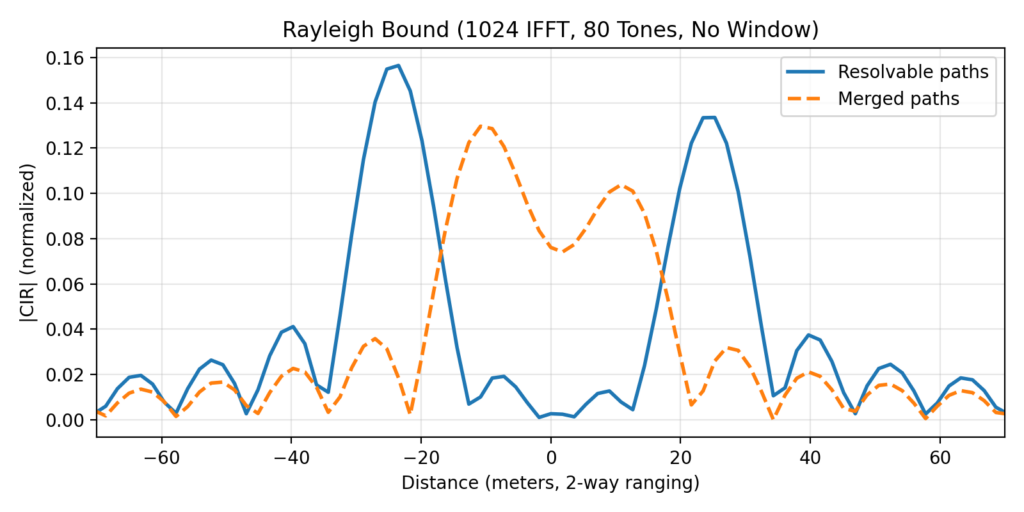
The Rayleigh bound describes the minimum separation required to distinguish two signal paths (e.g., direct path and reflection). It depends primarily on the effective bandwidth B:
- Time resolution ≈ 1 / B
- Distance resolution (2-way ranging) ≈ c / (2 × B)
- Defines multipath separability (resolution), not “accuracy”
- With ~80 MHz bandwidth, reflections within roughly ~1.8 m can blend together
- More bandwidth → finer time resolution → better path separation
Cramér–Rao Lower Bound (CRLB)
How precisely can we measure in noise?
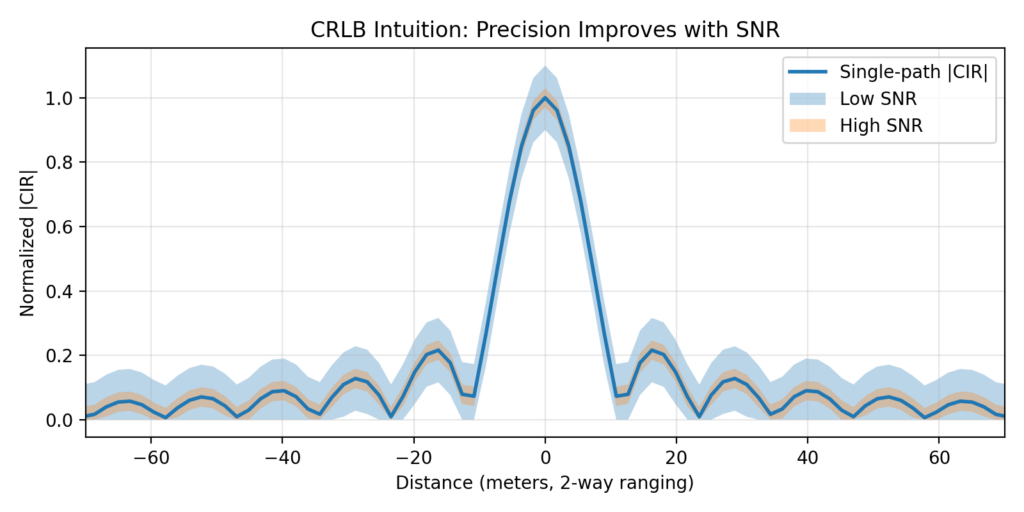
CRLB describes the best achievable statistical precision for an (unbiased) estimator in the presence of noise. A simplified takeaway:
Distance precision ∝ 1 / (B × √SNR)
- Defines noise-limited precision (accuracy in noise)
- Higher SNR → significantly better precision (improves with √SNR)
- Explains why sub-Rayleigh accuracy can be physically possible
What the Rayleigh bound means at typical bandwidths
Typical 2-way Rayleigh distance resolution scales approximately with c/(2B). Example values:
- 20 MHz → ~7.5 m
- 83 MHz (typical BLE span) → ~1.8 m
- 500 MHz → ~0.30 m
- 1 GHz → ~0.15 m
Rayleigh does not set the achievable accuracy directly — it sets how well close multipath components can be separated in the CIR.
What the CRLB means at ~80 MHz bandwidths
CRLB depends on both bandwidth and SNR. For ~80 MHz effective span, rule-of-thumb noise-limited distance precision is:
- SNR ~ 10 dB → ~0.75–1.15 m
- SNR ~ 20 dB → ~0.25–0.35 m
- SNR ~ 30 dB → ~0.08–0.12 m
This explains why a system can achieve sub-Rayleigh accuracy in clean LOS conditions: the Rayleigh bound limits path separability, while CRLB limits noise-driven precision.
Why SNR is critically important
Bandwidth influences both resolution and precision. However, SNR sets a fundamental information limit: if useful signal content is buried in noise, no signal processing algorithm can fully recover it. While we can try to improve resolution (e.g., with wider frequency span or multipath-mitigation techniques), low SNR directly limits achievable accuracy.
- Antenna performance and placement
- RF design quality and interference mitigation
- Transmit power (within regulatory limits)
- Controlled integration time / averaging (where allowed)
Why sub-meter error can still be a strong result indoors
Office spaces are highly dynamic RF environments: reflections from walls, glass, metal frames, furniture, and people moving around create time-varying multipath, often alongside interference from Wi-Fi and other 2.4 GHz systems. In these conditions, performance is frequently limited more by environmental physics (multipath + interference) than by estimator quality alone. Achieving accuracy within sub-meter in a typical office environment can therefore represent strong performance, even when strict requirements are challenging.
Big picture
- Rayleigh bound → limits multipath separability (resolution)
- CRLB → limits noise-driven precision (accuracy in noise)
- SNR → determines how close a system can approach the CRLB
- Indoor multipath → often introduces bias beyond both limits
Talk to us about your environment and requirements
If you’d like to discuss expected performance for your application (accuracy, robustness, power), please contact us.